
For more than two decades, the single most requested property in sportswear fabric has been moisture management. Yet most buyers still describe it simply as “breathable,” which tells me the technology behind it is widely misunderstood. Let me explain what moisture-wicking really is, how we engineer it, and why the fiber choice matters more than the finish applied afterward.
At its core, moisture wicking is the controlled transport of liquid sweat away from the skin to the outer surface of the fabric, where it can evaporate. Skin does not cool by sweating itself; it cools through the evaporation of that sweat. If a fabric traps sweat against the skin, evaporation is blocked, heat builds, and the athlete feels hot, heavy, and sticky. The entire mission of a wicking fabric is to accelerate evaporation while keeping the skin-side layer dry.
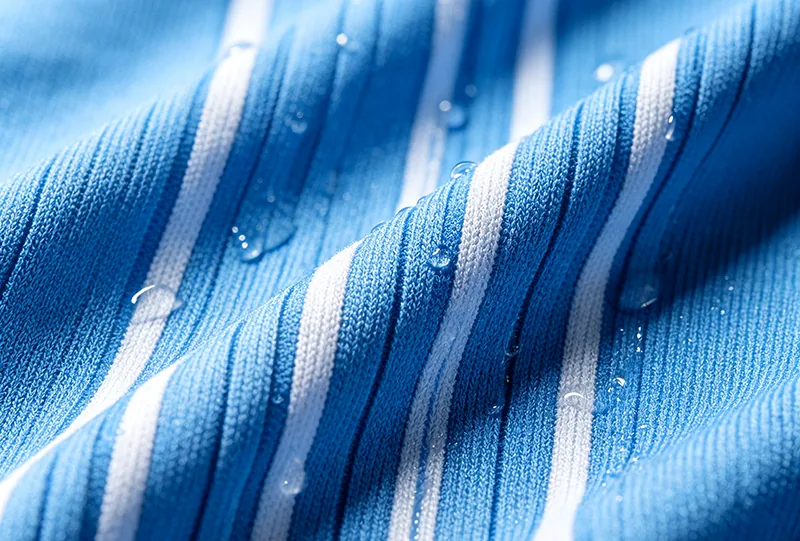
This transport depends on two phenomena: capillary action and differential hydrophilicity. The yarns are engineered with fine channels between and within filaments, and the fiber chemistry is tuned so that the inner face of the fabric has lower water affinity than the outer face. That gradient literally pulls moisture outward, layer by layer. In our development lab, we quantify this with a wicking-height test and a vertical wicking test, measuring how far water climbs in a specified time. The difference between a 30-millimeter climb and a 120-millimeter climb is the difference between a casual top and a competition base layer.
The fiber is the foundation. Polyester is the workhorse because it is hydrophobic, meaning it has low natural water retention and dries rapidly. But raw polyester does not transport sweat by itself, which is why we engineer the yarn cross-section. Classic circular, round-cross-section polyester traps air and moisture. By contrast, cross-sectional shapes such as four-channel, trilobal, and hollow fibers create capillary grooves along the filament. These grooves generate the wicking action. A 75-denier four-channel polyester microfiber, knitted at the right density, will out-wick a standard 150-denier yarn of the same weight every single time, and any engineer with twenty years in this trade can feel the difference at the touch.
Structure amplifies or destroys the fiber’s work. A tightly knit, smooth-surface fabric wicks faster than a loose, nubby one, because the liquid has a continuous path. But if the knit is so tight that it blocks airflow, the sweat reaches the surface and then cannot evaporate. That is why we design two-sided or zoned constructions: a plated knit with a coarse, moisture-absorbing outer layer and a smooth, quick-dry inner layer. The plated layer also gives the outer face a larger surface area for evaporation. This is not decoration; it is thermodynamics applied to yarn.
The finish is the third pillar. Hydrophilic finishes, usually a durable water-dispersible polymer, are applied to the inner face so that sweat spreads quickly over a larger area instead of beading in droplets. Beads are the enemy, because a droplet evaporates slowly and re-wets the skin. We always specify the number of home-laundry washes the finish survives, because many cheap finishes wash out in ten cycles, and the fabric quietly reverts to a clingy, sweat-trapping rag.
Testing is where real experience shows. We do not trust claims; we test on a sweating hot-plate to measure water-vapor transmission rate, and we run a full wash-and-dry cycle test to confirm the wicking survives fifty washes. We also check the drying time, which should stay under sixty minutes for most activewear in standard conditions. If a customer asks for “moisture-wicking fabric,” the first question I ask back is: which sport, how long will you sweat, and how many washes will this garment see in a year? The answer changes the fiber, the structure, and the finish.
A final word of honest advice: wicking fabric only performs when it fits properly. A tight compression layer can wick beautifully, but a loose, baggy version of the same fabric traps a layer of humid air against the body. The best wicking fabric in the world cannot fix a poor pattern. Pair the right engineering with the right fit, and you get what athletes call “dry performance.” That is what we have spent two decades learning to deliver, and it is why the details above matter far more than the marketing label on the hanger.
