
Early in my career, a veteran mill manager gave me a test that has never failed: hold a swatch of fabric in both hands and stretch it sideways. If it stretches easily, it is a knit; if it resists, it is a woven. It sounds trivial, but that single physical difference explains ninety percent of the decisions we make when choosing between the two for sportswear. Understanding why they differ is what separates a fabric buyer from a fabric engineer.
A knit is built from a single continuous yarn that loops into itself, row by row. Those interlocking loops are what give a knit its two-way give and its drape. A woven is built from two yarn systems, warp and weft, interlacing at right angles. The warp yarns are rigid in the loom, so a woven has little to no give in the warp direction. That is the entire structural story in one paragraph, and every performance property flows from it.
Knits dominate sportswear because movement demands stretch. A running short, a compression top, a training legging, a base layer, nearly all of it is knitted, because the body moves in three dimensions and a rigid shell would bind, tear, and restrict. Knits conform, recover, and follow the athlete. They are also faster to produce, which is why the knit category runs at volumes that woven can only dream of. When a customer says “athletic apparel,” in my head I hear “knit apparel,” because that is where the market lives.
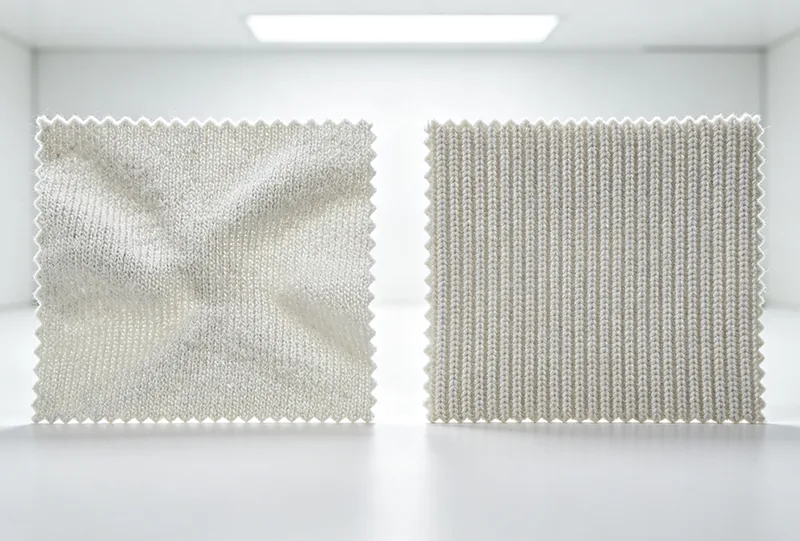
Wovens earn their place where stability and tear strength matter more than stretch. Windbreakers, softshell jackets, and outer layers are often woven, because a dense, stable face resists wind and snagging better than a looped knit. Woven climbing trousers, technical shorts, and some race-fit cycling pieces use the structure’s dimensional stability to hold a precise cut. A woven will not bag out the way a knit can, which is why trail and durability-focused garments lean woven. The trade is air and stretch for stiffness and toughness.
Within knits, the loop structure is itself a specification, not a fixed thing. A single jersey is light and stretchy; an interlock is doubled, stable, and slightly less stretchy; a rib has pronounced vertical stretch; a fleece carries a raised insulating back. Choosing the right structure for the sport is real engineering. For a running singlet, single jersey or a fine mesh. For a training tight, an interlock or a double-faced construction with spandex. For a hoodie, a French terry or fleece. Each is a different machine, different gauge, different cost, and different result.
Weaving’s structure also varies with intent. A plain weave is the baseline, flat and tight. A twill is diagonally ribbed, drapier and softer. A satin weave is smooth and lustrous on the face, used where sheen and glide are wanted. Dobby and jacquard weaves build complex patterns directly into the structure. In sportswear shells, twill and Oxford-style weaves with tight, high-density constructions are common, often coated or laminated for weather resistance. The weave structure sets the character as much as any finish.
The seam behavior differs in a way that affects garment durability. Knit seams can stretch with the body and are often sewn with coverstitch or flatlock that gives and prevents skin chafing. Woven seams must be reinforced because the fabric itself will not give; a stiff seam in a woven shell is a design feature, while in a knit it is a defect. Our pattern engineers treat the two fabrics as completely different materials, because seam behavior, edge fraying, and durability all depend on that fundamental structural identity.
The practical rule I give every new buyer is this: ask the athlete what they are doing, then let the fabric’s structure follow the movement. If the garment must stretch with the body through a full range of motion, knit it. If it must hold its shape against wind, rain, and repeated load, weave it. And if you are not sure, order both a knit and a woven sample and wear-test them, because no specification sheet will ever teach you what two hours of movement can.
