
Mesh is the fabric most people think they understand, and the one I have seen butchered more than any other in sportswear. Everyone knows mesh breathes. Far fewer know that mesh is a precision airflow device, and that a well-engineered mesh zone is worth more than a whole garment of “breathable” solid fabric. After twenty years of knitting performance textiles, I design mesh zones the way an engineer designs a heat sink: placement, geometry, and yarn all get deliberate thought.
The defining feature of a mesh fabric is openness, the proportion of the surface that is hole. That openness is created not by cutting holes but by the knitting itself, usually a tuck-and-miss pattern that pulls yarns together into solid bars separated by open voids. The geometry matters enormously. Hexagonal and rhomboid openings are common because they balance airflow with structural stability, while round openings distort under stretch. When we develop a mesh, we draw the knit diagram, count the open area, and verify it in the actual fabric, because the fabric gauge and yarn diameter change what the drawing predicts.
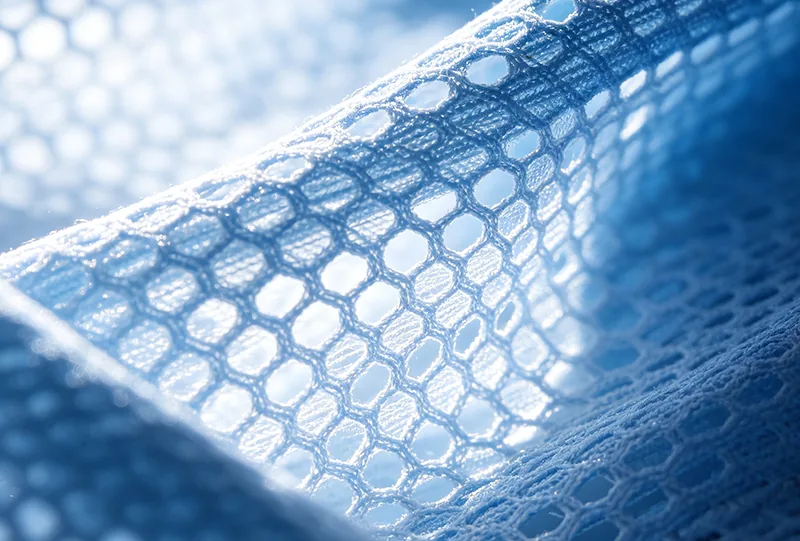
Airflow is only half the story; the other half is evaporation. A mesh zone works by channeling air to the skin so sweat can evaporate, and by wicking liquid away from high-sweat areas such as the underarm, the middle back, and the inner thigh. This is why the best garments place mesh exactly where heat and sweat concentrate, not randomly. We frequently knit mesh into the underarm gusset, along the spine, and at the collar and cuffs, where the body’s own thermal vents are. That is not a design trend; it is physiology.
Yarn choice changes mesh behavior completely. A fine, high-tenacity nylon or polyester filament keeps the openings stable so they do not stretch into holes over time. Coarser or staple yarns make a softer, more fabric-like mesh that breathes less but feels nicer against skin. A common error is specifying “mesh” without specifying openness, yarn, and weight, which yields a garment whose vents either flap uselessly or, worse, distort under tension and expose the athlete.
Dimensional stability is the hidden trap in mesh. Because mesh has less yarn mass holding it together, it shrinks, grows, and distorts more than solid fabric, especially under repeated washing and stretching. In production, we pre-shrink mesh panels and set them carefully, and we advise brands to expect a different shrinkage percentage on mesh versus solid panels in the same garment. If a multi-panel design does not account for this, the seams pucker and the garment twists. This is the kind of failure that shows up in the second wash, not the first, and it is expensive to fix after production.
Weight and GSM in mesh behave differently from solid fabric too. A 200 GSM mesh is dramatically more open and lighter-feeling than a 200 GSM jersey, because much of its area is air. So when buyers order mesh by GSM alone, they are frequently surprised by the result. We always pair mesh specifications with openness and hole dimension, and we recommend buyers feel a physical sample before committing to bulk, because no photograph communicates how a mesh behaves in the hand.
Lamination and bonding have opened a new chapter for mesh. Bonded mesh panels, fused to a solid base layer with adhesive film, create smooth, seamless cooling zones without stitching, and they reduce the abrasion and seams that irritate skin during long workouts. These constructions are now standard in premium cycling jerseys and high-end running tops, and they demand precise adhesive placement to avoid stiff spots. It is some of the most exacting work we do.
My closing advice to anyone sourcing mesh: treat it as a technical component, not a fabric. Specify the knit structure, the openness, the yarn type and denier, the weight, and the placement plan, and require physical samples before bulk. A mesh panel engineered with intent outperforms a garment covered in generic “breathable” fabric every time. That is not opinion; it is two decades of airflow measured in real garments, real sweat, and real races.
