
The first number any serious buyer asks about is GSM, grams per square meter. It is the fabric’s weight, and it is the closest thing our industry has to a shorthand for a fabric’s character. But after two decades in the mill, I have learned that GSM alone is dangerously incomplete. Weight tells you how much fabric is there, not how it will perform, and the same GSM can feel entirely different depending on fiber, structure, and finishing.
Understanding GSM starts with how it is measured and what it is not. We cut a precise circular sample, weigh it on a calibrated balance, and multiply to grams per square meter. It is an areal density, and it is the foundation of costing, because raw material is bought by weight. But a 200 GSM cotton jersey and a 200 GSM double-faced technical knit are as different as a t-shirt and a jacket. The number is real; the interpretation requires context.
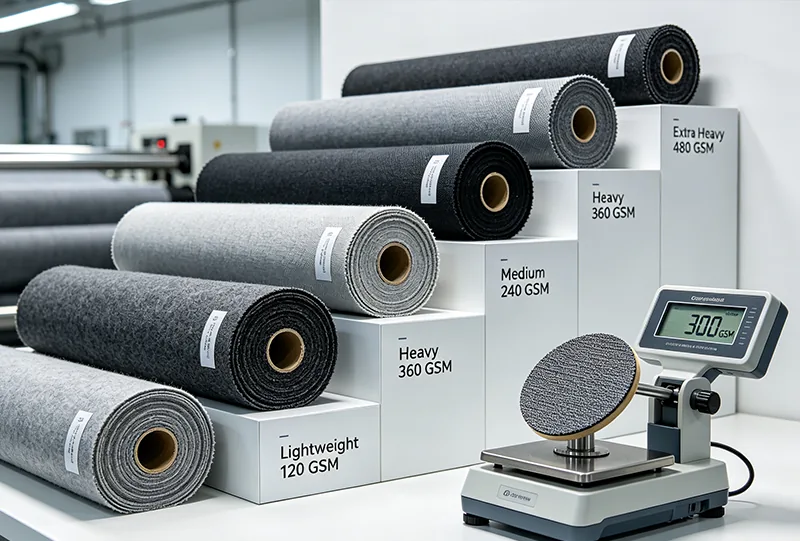
Different sports demand different weights, and this is where real engineering judgment shows. A base layer for running, meant to sit against skin and wick, typically runs 120 to 150 GSM, light enough to breathe, dense enough to hold structure. A mid-layer training top might rise to 180 to 220 GSM, carrying a bit more warmth and a smoother surface. Tights and compression pieces usually fall between 180 and 300 GSM depending on the desired power, and outer shells, warm-up jackets, and hoodies climb to 280 to 400 GSM. These ranges are starting points, not rules, but they reflect decades of trial on real athletes.
Weight interacts with fiber density in a way that surprises newcomers. Polyester at about 1.38 g per cubic centimeter is denser than nylon at 1.14, which means the same GSM of nylon is bulkier and warmer for the same weight. This is why nylon shells feel loftier, and why a 250 GSM nylon softshell can feel warmer than a 300 GSM polyester one. When a customer insists on a specific GSM for warmth reasons, I gently steer the conversation toward fiber and air content, because trapped air, not fiber mass, is what insulates.
The knit structure controls how weight is distributed. A single jersey is the lightest, thinnest structure per GSM. Interlock doubles the layer and traps air, giving warmth with structure. Terry and fleece trap loops of yarn that feel heavy in the hand but are soft and insulating. Double-face and bonded fabrics combine multiple layers into one weight number. Two fabrics can share a GSM yet have totally different hand, drape, opacity, and thermal behavior, which is precisely why we always pair the GSM figure with a structure name on our technical sheets.
Weight and opacity are linked in a way activewear buyers must respect. Thin fabrics, under about 150 GSM in most structures, can become translucent under stretch, which matters for tights and light-colored garments. If a brand wants a sub-150 GSM legging that stays squat-proof, we add a darker or heavier inner layer or a tighter construction, and that decision changes both weight and cost. Every weight specification is a negotiation among weight, opacity, breathability, and price, and the engineer’s job is to find the intersection that satisfies all four.
The cost equation is the last thing most buyers grasp, and I cannot blame them. Fabric price per meter is proportional to GSM multiplied by the fiber price, divided by the structure’s efficiency. Cutting 20 GSM from a fabric can shave real money from a program, but it can also push the fabric below a performance threshold, opacity limit, or drape quality, and the savings vanish in returns. Over my career, the most expensive mistakes have always been cheapening a fabric that was already right.
My rule after all these years is deceptively simple: never specify GSM alone. Specify weight, fiber composition, structure, and the performance numbers you need, and let them agree. A fabric that is correct on all four is worth more than any single number, and it is the only way to get a garment that performs as designed rather than merely as labeled.
